The Science of In-Venue Upselling: Turning Wait Screens into Revenue
TokenPager Team
Queue & Hospitality Tech
Key Insights
- •Point-of-sale upselling triggers natural consumer defense mechanisms and decision fatigue; post-purchase wait times reverse this dynamic.
- •According to McKinsey & Forrester, targeted cross-selling and upselling initiatives boost top-line transaction value by 10% to 30%.
- •Digital wait screens turn previously silent queue dwell time into a high-converting, visual merchandising display right on the customer's personal phone.
Post-Purchase Idle Window: The relaxed interval between order payment and fulfillment where customer buying defenses drop, anticipation peaks, and visual smartphone attention reaches its maximum.
The Flaw of the High-Pressure Register Pitch
In traditional retail and hospitality, upselling has long depended on a single high-pressure moment: the point of sale.
A cashier asks, "Do you want fries with that?" or "Would you like to upgrade to our premium car wash package?" More often than not, the customer's immediate, instinctive reaction is a reflex "No, thanks."
Why does this happen? Because at the register, customers face acute decision fatigue. Their hands are full with credit cards, purses, or car keys, an impatient line of people is queuing directly behind them, and their cognitive defense mechanisms are on high alert. The customer's primary psychological objective is simply to complete the financial transaction and step aside.
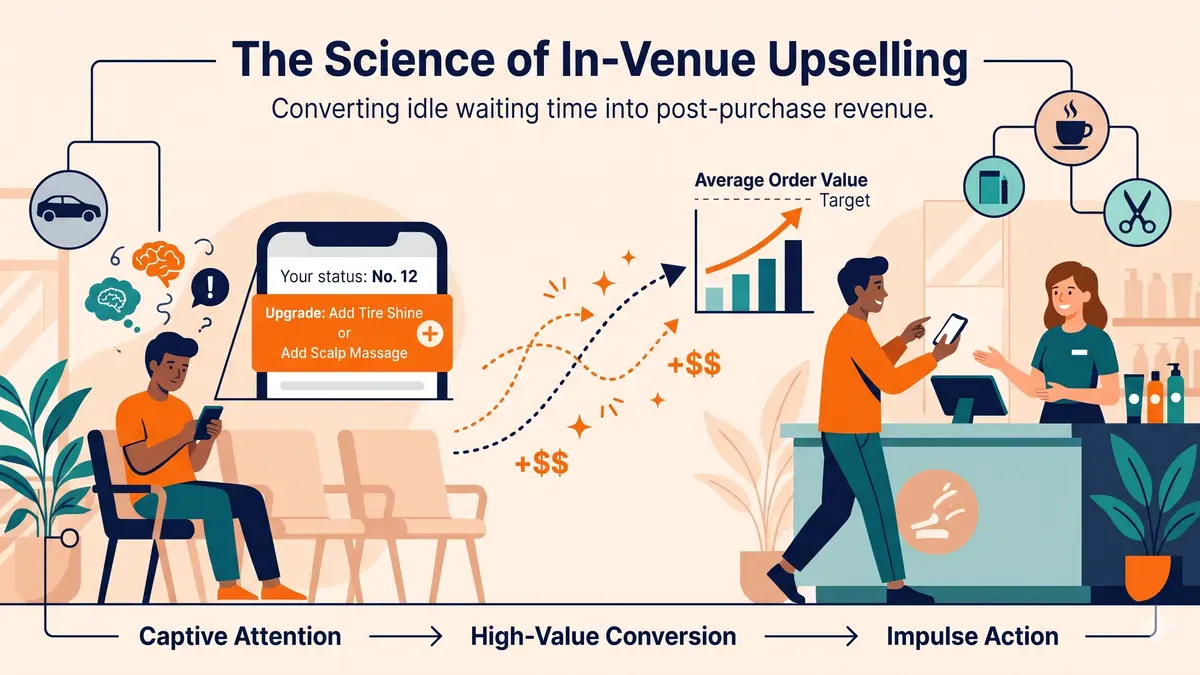
However, consumer behavioral psychology reveals that the most effective window for upselling isn't at the counter before paying—it happens immediately after the transaction, while the customer is waiting.
The Behavioral Psychology of Post-Purchase Buying
Behavioral economists and consumer researchers identify three distinct psychological drivers that make waiting customers exceptionally receptive to add-on offers:
1. The Commitment and Consistency Principle (Commitment Before Add-On)
In a landmark behavioral study published in the Journal of Personality and Social Psychology, Dr. Robert Cialdini and his research team demonstrated the psychological power of sequential compliance (Cialdini et al., 1978).
The researchers found that once an individual actively commits to an initial decision, an internal psychological momentum takes over. Even when supplementary costs or additional requests are introduced immediately afterward, people overwhelmingly follow through—because canceling or refusing conflicts with their internal drive to remain consistent with their original choice.
In a brick-and-mortar venue, this psychological sequence explains why counter upsells fail while wait-screen upsells succeed:
• At the counter (Pre-Commitment): The customer has not finalized their decision. Introducing an upsell adds cognitive friction, increases perceived risk, and triggers defensive hesitation.
• On the live wait screen (Post-Commitment): The customer has already committed—they chose your venue, paid, and initiated their order. Because the initial hurdle is cleared, their self-image is settled as a paying patron. An add-on prompt (such as a beverage, detailing upgrade, or spa enhancement) is no longer processed as a cold sales pitch, but as a natural, low-resistance completion of the choice they already made.
2. Overcoming "Decision Friction" in Idle Downtime
At the cash register, seconds feel like minutes. A customer rejects an upsell simply to escape the transaction quickly. During the wait time, however, the dynamic reverses completely: the customer has idle dwell time with nothing to do. Browsing a visually appealing add-on or seasonal promotion on their smartphone screen provides welcome stimulation rather than unwanted friction.
3. The "Impulse Window" Before Order Fulfillment
In service and dining environments, cravings and anticipation peak while waiting:
• Coffee Shops & Bakeries: A customer tracking their espresso brew timer realizes a warm, fresh-baked almond croissant sounds irresistible.
• Car Washes & Auto Spas: A driver waiting for their basic wash cycle sees an on-screen preview of tire shine or ceramic rain repellent.
• Salons & Barbershops: A client waiting for their haircut reviews an introduction to an invigorating 10-minute scalp treatment.
When customers wait, their cognitive defense shields are down. Presenting low-friction add-ons during queue dwell time unlocks up to 30% incremental transaction revenue without increasing overhead.
Turning passive waiting minutes into active visual merchandising transforms your highest-traffic window into pure profit margin.
Why Legacy Paging Kills Add-On Revenue
For decades, venues have handed waiting patrons plastic coaster buzzers or paper ticket stubs. These outdated tools carry an enormous hidden opportunity cost: they are completely silent.
A plastic buzzer cannot announce that your kitchen just pulled fresh cinnamon rolls from the oven, that your bar has a 2-for-1 craft draft special starting in 15 minutes, or that your auto shop offers a discounted seasonal detailing package. It delivers zero context until it vibrates.
By moving your paging and queue management to a 100% web-based digital status screen, every minute of idle customer attention becomes an active, visual merchandising display.
Real-World Upsell Playbook Across Verticals
You don't need sprawling ad copy or complex marketing funnels to prompt an add-on. Short, targeted promotional cards and micro-copy displayed directly above the customer's live token status trigger rapid action:
1. Quick-Service Restaurants & Cafes (Immediate Add-Ons)
Promote low-prep items that require zero extra kitchen lag time:
• "Add a warm cookie to your tray!"
• "Ask for an iced matcha at pickup"
• "Upgrade to large seasoned fries for $1"
2. Auto Detailing & Car Washes (Service Upgrades)
Introduce high-margin protective treatments or recurring memberships while the vehicle is in the bay:
• "Add ceramic rain repellent at counter"
• "Ask staff for tire dressing upgrade"
• "Join our unlimited monthly wash club"
3. Salons, Spas & Wellness (Treatment Enhancements)
Suggest quick treatments that fit seamlessly into their booked appointment slot:
• "Add a 10-min scalp massage today"
• "Ask stylist for deep conditioning"
• "Take home professional styling products for 20% off"
4. Entertainment Venues & Family Centers (Next-Round Upsells)
Target patrons waiting for their lane, race, or table with refreshments or extended play:
• "Order craft beers directly to your lane!"
• "Add an extra 30 minutes for half price"
• "Book your upcoming birthday party with us"
Measuring the Impact on Average Order Value (AOV)
According to extensive retail analytics from Forrester and McKinsey, cross-selling and upselling initiatives contribute up to 10% to 30% of total revenue. Digital wait screens bring this proven e-commerce mechanism into physical brick-and-mortar operations.
Even if only 4 out of 100 waiting customers walk back to the counter to add an item or upgrade their service, the cumulative impact across hundreds of daily transactions directly expands top-line margin without increasing your marketing budget or staff overhead.
TokenPager turns your guest status screen into an automated digital billboard, giving your highest-margin specials the spotlight they deserve while eliminating physical buzzer replacement expenses permanently.
Counter Checkout vs. Post-Purchase Wait Screen Upselling
Zero Decision Pressure
Customers browse add-ons autonomously on their phones without an impatient queue hovering behind them.
Peak Anticipation Window
Appetite and visual cravings peak while waiting for food, coffee, car detailing, or grooming to finish.
High-Margin Incremental Gains
Even a modest 4% to 8% add-on conversion rate yields pure profit margin on existing counter foot traffic.
Replaces Dumb Plastic Buzzers
Legacy hardware buzzers are completely blank; digital web tokens turn every minute of dwell time into active merchandising.
"Once an active commitment is secured, the internal psychological drive to remain consistent ensures that supplementary additions are met with drastically reduced resistance."
Wait-Screen In-Venue Upsell & AOV Calculator
Calculate how much extra top-line revenue and margin your venue can unlock by promoting low-friction add-ons directly on customers’ mobile pager screens.
Customers who walk back to counter or request add-on.
Incremental gross receipts per operational day.
Added directly to your revenue without adding cashiers, buying plastic pagers, or increasing ad spend.
Deploy TokenPager in 5 Minutes
Turn customer waiting into a positive, branded experience. Zero hardware costs, zero app downloads, and no phone numbers required.
Keep Learning
View AllTurning Wait Times into Repeat Customers with Social Media
Convert idle customer waiting minutes into permanent Instagram followers, direct repeat bookings, and recurring revenue using interactive mobile wait screens.
How to Manage Queues: Psychology, Topology & Throughput
Discover the operational system behind effective queue management: cognitive waiting psychology, physical space topology, and Little's Law throughput pacing.
The Complete Guide to Modern Guest Pager Systems: Buzzers vs. Web Apps
Explore the evolution of guest pager systems. Learn why restaurants and cafes are replacing expensive plastic buzzers with low-friction, zero-hardware digital pager web apps.
Frequently Asked Questions
Common questions regarding this guide and modern paging workflows.