How to Manage Queues: Psychology, Topology & Throughput
TokenPager Team
Queue & Hospitality Tech
Key Insights
- •Waiting duration is perceived through emotional arousal and cognitive load; transparent time estimates reduce perceived wait time by over 30%.
- •The Peak-End Rule dictates that an ambiguous, frustrating wait at the front counter will become the dominant memory of the entire service experience.
- •Decoupling ordering intake from fulfillment prevents service bottlenecks and enforces Little's Law throughput stability during rush hours.
Temporal Anchoring: The cognitive practice of communicating explicit, real-time wait estimates that transform open-ended, stressful delays into predictable, autonomous appointments.
The Psychology of Waiting: Cognitive Bias & Temporal Perception
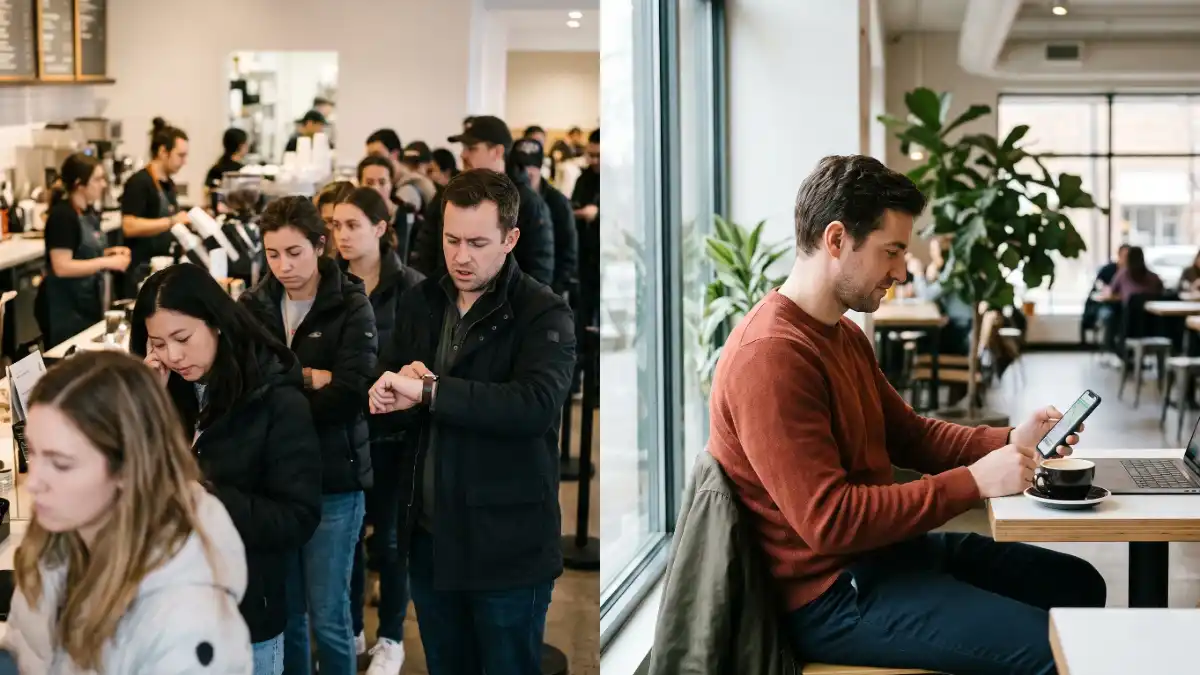
Queue management is fundamentally an exercise in cognitive psychology. The human brain does not measure elapsed time like an atomic clock; it measures time through emotional arousal, mental bandwidth, and perceived momentum.
When venues fail to account for how customers process waiting, four specific behavioral biases trigger walkouts and negative reviews:
1. The Peak-End Rule and Memory Construction (Daniel Kahneman)
Behavioral economists show that customers do not evaluate an experience by averaging every minute spent at a venue. Instead, their memory of service quality is heavily weighted by two anchor points: the emotional peak (the highest point of delight or friction) and the end (the final hand-off).
A chaotic, uncertain 15-minute wait at the start or an ambiguous pickup at the counter becomes the dominant "peak friction" event, completely overriding the quality of the meal, haircut, detailing job, or game that follows.
2. The Goal-Gradient Hypothesis (Hull's Acceleration Principle)
Originally identified in behavioral psychology by Clark Hull, the Goal-Gradient Effect shows that humans exert more patience, tolerate higher effort, and experience less frustration the closer they perceive themselves to the finish line.
• The Problem: In an opaque queue (like an unnumbered crowd or a silent buzzer), the customer's brain perceives distance to completion as zero progress.
• The Fix: Displaying a staged progress sequence (e.g., Order Placed → In Progress → Final Inspection → Ready) creates visible, forward momentum. The closer the visual indicator moves toward fulfillment, the more patient and cooperative the customer becomes.
3. Chronostasis and Cognitive Load (The "Watched Pot" Effect)
In cognitive neuroscience, chronostasis describes the temporal illusion where the brain overestimates duration when attention is hyper-focused on the passage of time itself.
When a patron stands in an empty lobby staring at a counter or a static wall clock with no cognitive distraction, their working memory focuses entirely on counting elapsed seconds. When that same customer is given an interactive, visual medium—such as a live mobile status screen displaying step-by-step updates—the mental spotlight shifts away from duration estimation, effectively compressing perceived wait times by 30% or more.
4. Explicit Temporal Anchoring (The Certainty Effect)
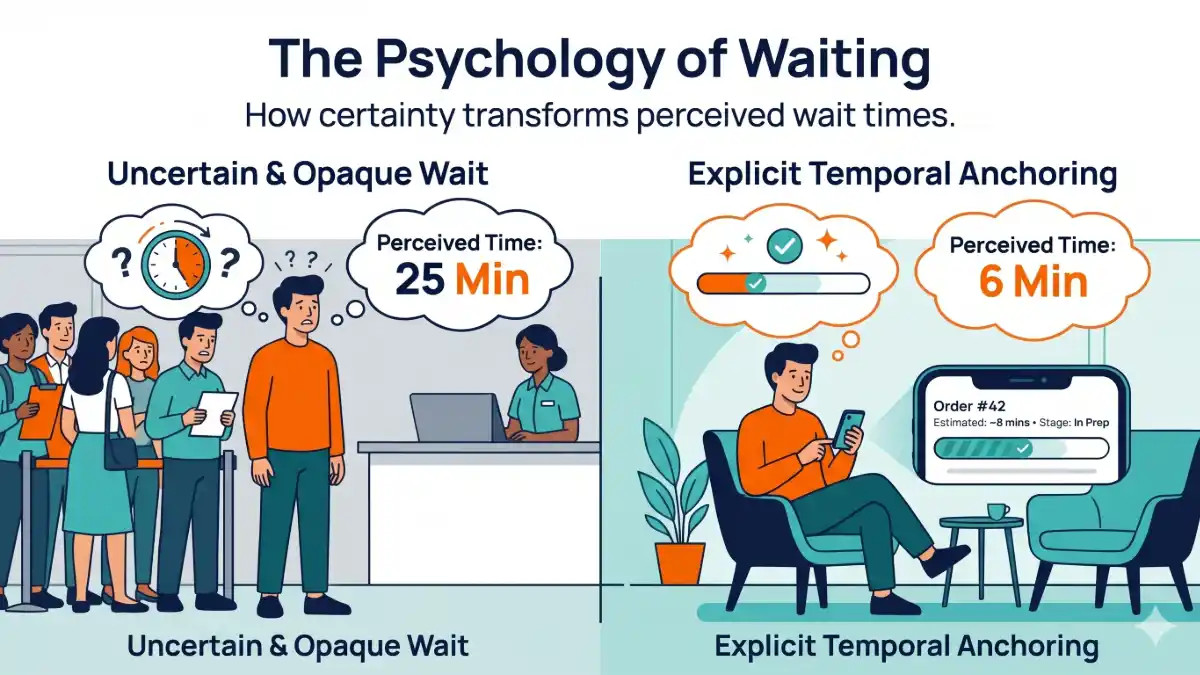
In behavioral economics, ambiguity produces a measurable stress response. When a wait time is unknown, customers default to worst-case duration modeling, constantly evaluating whether to renege.
Communicating an explicit, real-time wait duration transforms the wait from an ambiguous delay into a bounded appointment:
• The Certainty Premium: Knowing an order will take 11 minutes triggers significantly less cognitive friction than waiting 7 minutes without an estimate. The brain shifts from an anxious state of hyper-vigilance ("Have they forgotten my order?") to autonomous scheduling ("I have 11 minutes to sit, check my email, or browse").
• Expectation-Disconfirmation Theory: Customer satisfaction is not determined by absolute speed, but by performance relative to expectations. When a system transparently sets a dynamic baseline (e.g., Estimated time: 10–12 mins) and fulfills within that window, perceived service quality rates higher than if the exact same duration had passed without upfront communication.
• Autonomous Dwell Freedom: Explicit time transparency restores personal agency. When guests know exactly how much time remains—whether tracking via a browser monitor like TokenPager or an in-house departure board—counter crowding resolves naturally because patrons feel secure stepping away from the service threshold.
Cognitive drivers of queue perception: The Peak-End Rule, Goal-Gradient Momentum & Chronostasis
When customers hit their cognitive threshold of uncertainty, they execute one of two lost-revenue behaviors: balking (leaving before ordering) or reneging (abandoning their place in the queue after ordering). Fixing queue flow requires eliminating this cognitive friction by providing clear, continuous, and transparent progress indicators.
The 4 Queue Management Systems: Comparing Operational Models
Venues typically rely on one of four operational models to handle customer volume, each with distinct trade-offs in intake friction, overhead cost, and guest experience:
1. Analog Intake (Paper Tickets & Shouting Numbers)
Customers take a paper slip or receipt number, and staff shout names or numbers across the counter. This creates a noisy, chaotic environment, forces guests to crowd directly around the pickup area to avoid missing their call, and blocks incoming customer traffic.
2. Hardware Pagers (Plastic Coaster Buzzers)
Guests receive a battery-powered plastic disc that flashes and vibrates when their order or table is ready. While it frees customers from standing directly at the register, it introduces high initial capital costs, messy charging stacks, constant sanitation overhead, and ongoing replacement fees when buzzers are dropped, damaged, or lost. For an in-depth financial breakdown across major suppliers, read our LRS vs. Retekess vs. JTECH Pager Comparison.
3. SMS Text-Notification Platforms
Cashiers take down the customer's phone number at checkout and trigger an automated SMS when the order is fulfilled. However, this creates severe intake friction during peak rushes, triggers privacy hesitation from diners who dislike surrendering phone numbers to marketing databases, and incurs recurring monthly carrier gateway fees. See our full breakdown of Waitwhile Pricing & SMS Limits.
4. Zero-Hardware Digital Queuing (Counter QR & Browser PWA)
Customers scan a counter stand QR code using their default smartphone camera. A lightweight web screen (such as TokenPager) displays their live token status and estimated wait-time, alerting them with audio and vibration when ready. It requires zero native app downloads, collects no personal contact details, eliminates physical hardware upkeep, and decouples waiting from the physical counter.
Structural Queue Topology: Designing Physical Floor Flow
Even the best alerting system fails if physical intake and fulfillment lines collide. To eliminate counter congestion, choose the right structural layout for your space:
Single-Line, Multiple-Servers (Serpentine Queue)
Customers wait in one consolidated, winding line and step up to the next available register or bay. This eliminates "line regret" (the frustration of choosing a line that gets stuck behind an indecisive patron) and enforces strict First-In, First-Out (FIFO) fairness. It is ideal for fast-casual counter service, peak lunch rushes, and wash intake bays.
Multi-Line, Multi-Servers (Parallel Queues)
Customers pick an individual line tied to a specific staff member or terminal. While easy to set up, it produces high duration variance: a single complex transaction stalls everyone behind it while adjacent queues move freely, generating perceived unfairness. It is best reserved for operations where basket sizes differ radically.
Virtual Queuing (Decoupled Flow)
The physical line is removed entirely. Guests check in, receive a live digital status, and disperse until called. Physical floor space no longer limits guest capacity, and service counters remain open for active ordering while patrons wait comfortably in lounges or outdoor seating areas.
Eliminating the "Counter Huddle" Without Hardware Buzzers
In many fast-casual concepts, coffee shops, and food trucks, a secondary queue forms spontaneously: the pickup counter huddle. Even after placing an order, patrons cluster around the expediting window out of fear of missing their name or having their food sit cold.
Physical plastic buzzers fail to solve this because patrons fear dropping out of range. A zero-hardware web pager removes this anxiety entirely: by providing real-time countdown progress and unmistakable haptic phone vibration, customers feel completely secure stepping 50 feet away to sit or explore neighboring storefronts. The result is an open, unblocked counter threshold that speeds up order handoffs by 35%.
Throughput Pacing: Applying Little's Law to Service Lines
Queue size is governed by a fundamental operations formula known as Little's Law: Queue Length = Arrival Rate × Wait Time.
During peak arrival spikes, you cannot immediately slow down the influx of customers. To prevent the queue from backing up into the street or parking lot, you must compress the Wait Time through intake triage and standard operating procedures:
• Decouple Intake from Expediting: Never allow the employee taking an order or checking in a vehicle to assemble items, mix drinks, or fetch keys. Keep order entry moving at a fixed, rapid tempo.
• Set Visual Work-in-Progress (WIP) Limits: Cap the number of active tickets allowed in prep stations simultaneously. Overloading the kitchen line or detailing bay creates bottlenecks and lowers overall output speed.
• Streamline Peak Intake Options: Offer simplified, high-velocity menus or service packages during rush hours to shave 20–30 seconds off every transaction.
Industry-Specific Queue Execution Across Verticals
Apply these operational adjustments based on your specific venue layout:
• Restaurants, Cafes & Food Trucks: Clear the pickup counter threshold. Direct customers to sit down or step aside immediately after ordering, alerting them digitally only when the tray or bag is sitting on the collection ledge.
• Auto Detailing & Car Washes: Keep vehicle owners out of active work zones. Let customers wait in nearby lounges or retail shops with live, multi-stage progress tracking (Intake → Wash → Polish → Ready) to eliminate repetitive status inquiries.
• Salons & Barbershops: Manage walk-in spikes without packing waiting couches. Digital tokens allow clients to run local errands and return precisely when their styling chair is sanitized and ready.
• Entertainment Centers (Arcades, Bowling, Axe Throwing): Monetize the holding pattern. Keep waiting groups active at the bar or arcade floor where they continue spending money, rather than standing idle by the check-in desk.
The Throughput Audit: Measuring Queue Health
Audit your queue performance weekly using three primary operational metrics:
1. Abandonment Rate: The percentage of customers who leave before ordering (balking) or walk away during the wait (reneging).
2. Intake-to-Fulfillment Ratio: Whether intake registers are processing tickets faster than service bays or kitchen stations can deliver them.
3. Dwell Time: The exact minutes elapsed between ticket creation and completed hand-off.
A well-architected queue system balances clear spatial design with transparent, real-time status updates—transforming a chaotic holding area into an efficient, predictable operational pipeline.
Comparing the 4 Primary Queue Management Systems
Analog Calling (Paper / Shouting)
High noise, counter crowding, and zero privacy; forces patrons to cluster around collection thresholds.
Hardware Buzzers (Plastic Discs)
High initial capital expense, messy charging racks, constant sanitation overhead, and dropped replacement costs.
SMS Text Alerts
Creates intake friction collecting 10-digit phone numbers, triggers spam anxiety, and adds recurring carrier gateway fees.
Zero-Hardware PWA (TokenPager)
Instant QR code scan, 100% anonymous without apps or numbers, real-time status updates, and zero hardware upkeep.
"Provide a clear, unambiguous conceptual model of how the line operates... One of the major determiners of emotional unhappiness is fear of the unknown and uncertainty. Provide ample feedback. Estimate the duration... This minimizes uncertainty while also providing reassurance."
Deploy TokenPager in 5 Minutes
Turn customer waiting into a positive, branded experience. Zero hardware costs, zero app downloads, and no phone numbers required.
Keep Learning
View AllWaitwhile Alternatives & Pricing: The Hidden Cost of SMS Limits (2026)
A transparent 2026 breakdown of Waitwhile pricing, visitor caps, and SMS credit auto-refills. Compare top waitlist alternatives and explore zero-SMS web paging.
LRS vs. Retekess vs. JTECH vs. VEVOR: 2026 Pager Cost, Range & Alternatives
Compare LRS, Retekess, JTECH, and VEVOR on price, range, and shrinkage. See why restaurants and food trucks are switching to zero-hardware web pagers in 2026.
5 Best Restaurant Pager Alternatives to Replace Buzzers in 2026
Compare the leading restaurant pager alternatives in 2026. Eliminate buzzer replacement costs, shrinkage, and counter clutter with modern digital paging solutions.
Frequently Asked Questions
Common questions regarding this guide and modern paging workflows.