Waitwhile Alternatives & Pricing: The Hidden Cost of SMS Limits (2026)
TokenPager Team
Queue Architecture & Operations
Key Insights
- •Waitwhile bases billing on monthly registered "Visits" (not completed orders) combined with a variable pay-as-you-go SMS credit auto-refill model.
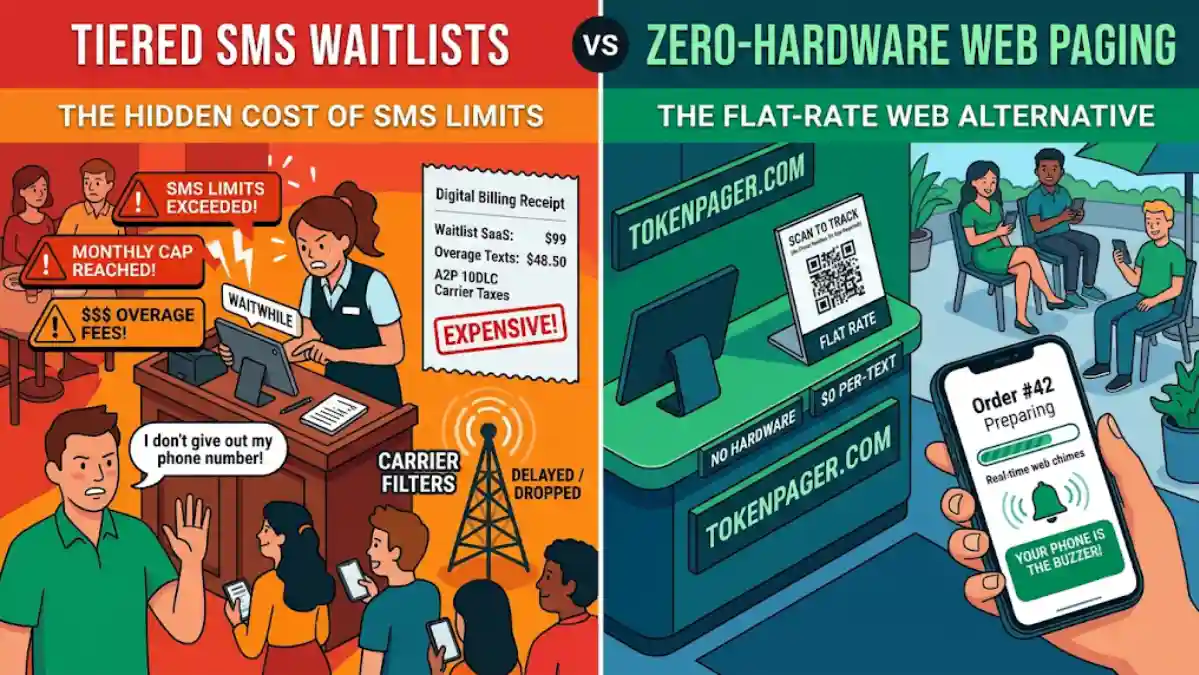
- •Outbound SMS messages cost roughly $0.08 per 160-character segment, meaning a 2-segment text with an emoji or custom pickup link costs ~$0.16 per alert.
- •Exceeding monthly visit quotas locks your waitlist from registering new walk-in guests until upgraded or the next billing cycle begins.
- •Browser-based web pagers eliminate SMS billing entirely by streaming instant haptic vibrations, sound chimes, and live status directly through standard web APIs.
SMS Segmentation Toll: The telecom billing practice where text messages exceeding 160 characters (or 70 characters if containing an emoji) are split into multiple billed segments, doubling or tripling per-message carrier fees for waitlist software.
The 2026 Waitwhile Pricing Dilemma: Powerful Software, Hidden Variable Bills
If you run a high-volume restaurant, medical clinic, salon, or retail boutique in 2026, Waitwhile is frequently one of the first digital waitlist apps you encounter. Its interface is polished, supports appointment scheduling, and includes robust team analytics.
However, search Reddit communities like r/restaurateur and r/restaurantowners, and a recurring frustration emerges: the disconnect between base subscription prices and actual monthly invoices.
Between strict monthly visitor allowances, per-location surcharges, and telecom SMS credit auto-refills, small and mid-sized venue owners frequently find what appeared to be a $29 to $59 monthly plan scaling into a $200+ monthly operational cost. Here is an honest breakdown of how Waitwhile pricing operates in 2026, and the best alternatives to consider.
Deconstructing the Waitwhile Pricing Structure
1. The Monthly "Visit" Quota Trap
Unlike traditional POS systems that charge flat platform fees, Waitwhile meters accounts based on Visits. Crucially, a visit is counted the instant a party enters your waitlist or books an appointment—regardless of whether they walk away, cancel, or actually dine.
• Free Tier: Capped at 50 to 100 monthly visits for 1 location. While helpful for testing, a single weekend shift at a busy 50-cover restaurant exhausts this cap in under 48 hours.
• Starter Tier (~$29–$59/mo): Expands visit volume, but remains strictly metered. If an unexpectedly busy holiday weekend pushes your guest count beyond your tier, your waitlist locks—preventing staff from adding walk-in patrons until you upgrade.
• Business Tier ($100+/mo): Required for operations demanding higher visit caps, custom branding, and multi-queue routing.
2. The Telecom Toll: Auto-Refill SMS Credits
The largest surprise for most operators is that SMS text messages are not included as unlimited in base plans.
Waitwhile operates an auto-refill Message Credit model. Standard outbound SMS messages run approximately $0.08 per 160-character segment in the US (with higher international rates). If your confirmation text includes an emoji (e.g. "🍕 Your table is ready!") or a long order tracking link, telecom encoding protocols (UCS-2) slash your character limit from 160 characters down to 70 characters.
A single notification can instantly become a 2 or 3-segment message costing $0.16 to $0.24. In a venue seating 150 parties per day, texting each party upon join, status update, and table call consumes 450 message segments daily—adding $36/day ($1,080/month) in telecom message bills alone.
Operational Bottlenecks of SMS-Based Waitlists
Beyond the financial costs of SMS credits, relying on text messaging introduces three critical operational bottlenecks at your host stand:
1. The 20-Second Register Bottleneck
During a peak Friday dinner rush, front-of-house intake speed is paramount. When using an SMS waitlist, host staff must verbally ask for the guest's 10-digit phone number, confirm the area code, and type it manually into an iPad. If a digit is mistyped, the guest never receives the call. This creates an unnecessary 20-to-30 second intake bottleneck per party, backing lines out the front door.
2. The International Tourist Failure
For venues in metropolitan hubs, airport districts, or tourist destinations, 15% to 30% of diners carry international SIM cards or travel on local Wi-Fi with cellular roaming disabled. Standard SMS gateways routinely drop international carrier messages, resulting in costly table walkaways and frustrated diners.
3. Customer Privacy Hesitation
Modern diners are increasingly reluctant to surrender personal phone numbers to casual dining counters for fear of automated SMS marketing spam and marketing retargeting. Forcing phone number entry introduces unnecessary friction before the customer has even placed an order.
Remote Waitlists vs. On-Site Virtual Pagers: Do You Actually Need an Online Queue?
Before committing $100+ per month to enterprise waitlist software, ask a fundamental operational question: Do you actually need people joining your line from their couch, or do you need to manage customers who are already at your venue?
1. The Remote Waitlist Trap: "Ghost Queues" & No-Shows
Platforms like Waitwhile, Yelp, and OpenTable allow prospective diners to join a queue remotely from miles away. While this sounds convenient on paper, ask restaurant managers on Reddit and you discover the operational fallout: a 30% to 40% ghost-queue no-show rate.
Customers join three different restaurant waitlists on their phones while deciding where to eat. When their table is called, they are still 15 minutes away—or dining somewhere else entirely. Your front-of-house staff is left holding empty tables, losing precious dining turnover while waiting for parties who never arrive.
2. The "Virtual Line Jump" Frustration
Worse, remote line-joining alienates physical walk-in customers. A family walks into your venue, sees three open tables, and is told: "Sorry, there is a 45-minute wait because parties joined on Yelp from their living room." This creates immediate friction and bad reviews from the high-intent patrons who actually made the effort to visit your venue in person.
3. On-Site Virtual Pagers: The Presence Guarantee
This is where the distinction between a remote booking engine and an on-site virtual pager becomes critical:
• If you operate an upscale reservation-only restaurant or a medical appointment clinic where clients must book 3 days in advance from home, an enterprise scheduling platform like Waitwhile or OpenTable is necessary.
• But if you operate a busy fast-casual spot, food truck, taproom, counter cafe, or high-volume walk-in dining room, paying for remote scheduling is expensive software overkill. You do not need to text people in other neighborhoods; you simply need to notify the customers already outside your door that their food or table is ready.
TokenPager is intentionally engineered as an On-Site Virtual Pager. Customers scan a QR code at your counter, front kiosk, or receipt. Because they must scan the physical QR code on premise, you guarantee physical presence. There are zero ghost queues, zero table lag, and zero money wasted texting people who never show up.
Side-by-Side: Waitwhile vs. Leading Waitlist Alternatives
The table below compares Waitwhile against popular queue platforms across pricing model, messaging technology, and counter workflow:
| Platform | Pricing Model | Paging Method | Guest Intake | Best For |
|---|---|---|---|---|
| Waitwhile | $29–$100+/mo + SMS credits | SMS Text (~$0.08/seg) | Manual host iPad or tablet QR | Enterprise salons, corporate DMV queues |
| Yelp Guest Manager | $99–$299/mo (Bundled) | SMS + Yelp Consumer App | Host iPad entry | Full-service spots relying heavily on Yelp traffic |
| Waitlist Me | $19.99–$39.99/mo | SMS (100–500 texts included) | Host iPad entry | Budget casual dining with low monthly volume |
| TokenPager | Flat / Free tier ($0 SMS) | Web Vibration & Audio PWA | Instant 2-sec QR scan | Food trucks, busy cafes, restaurants, pop-ups |
The Modern Zero-SMS Alternative: TokenPager
Instead of paying continuous telecom tolls and dealing with 10DLC brand registration, modern venues are moving their queue management to Zero-SMS Progressive Web Apps (PWAs) like TokenPager.
How It Works:
1. Frictionless QR Check-in: Diners scan a tabletop stand or receipt QR code. A live digital token opens immediately in their mobile browser—no phone numbers collected, no emails required, and zero app downloads.
2. Browser-Level Haptics & Chimes: When your staff calls the order from any phone, tablet, or POS screen, TokenPager utilizes native browser APIs (Web Vibration API and Web Audio API) to buzz the customer's phone and sound a clean pickup chime.
3. Zero Telecom Taxes: You never purchase message credits, never register with telecom syndicates, and never pay carrier overage penalties.
4. Universal International Compatibility: Works seamlessly over venue Wi-Fi or cellular data for every international tourist without roaming restrictions.
Waitwhile vs. TokenPager: Operational Comparison
SMS Message Pricing
~$0.08 per 160-char text segment via auto-refill credits vs. $0 with TokenPager (uses Web Audio/Vibration).
Monthly Visit Thresholds
Strict monthly guest visit caps (waitlist locks upon reaching quota) vs. unlimited guest turnover.
Front-Desk Intake Speed
20-second manual phone number entry by counter staff vs. 2-second instant customer QR scan.
International Diner Delivery
International SMS failure / roaming carrier blocks vs. 100% universal browser compatibility over Wi-Fi.
Try It: Test The Virtual Buzzer Right Now
Experience what your guests feel when their order is ready. No app install required.
Downtown Artisan Kitchen
— powered by TokenPager.com
Virtual Pager Active
This screen buzzes & chimes when your order is called.
Haptics & Audio ReadyCold Brew Refill +$2
Turn idle wait times into immediate counter upsells
Tap to test instant vibration & chime!
How The Virtual Buzzer WorksTest The Virtual Buzzer Right Now
When your counter staff calls a token, your guest's phone instantly wakes up:
- ✓Fires native haptic vibration in their pocket or hand
- ✓Sounds a clean dual-tone chime so they never miss pickup
- ✓Paints the screen emerald green with their pickup token
- ✓Zero app downloads and zero phone numbers needed
Deploy TokenPager in 5 Minutes
Turn customer waiting into a positive, branded experience. Zero hardware costs, zero app downloads, and no phone numbers required.
Keep Learning
View AllLRS vs. Retekess vs. JTECH vs. VEVOR: 2026 Pager Cost, Range & Alternatives
Compare LRS, Retekess, JTECH, and VEVOR on price, range, and shrinkage. See why restaurants and food trucks are switching to zero-hardware web pagers in 2026.
The Science of In-Venue Upselling: Turning Wait Screens into Revenue
Discover why post-purchase wait time delivers 10x higher upselling conversion than high-pressure register checkouts, and how digital wait screens lift average order value.
Turning Wait Times into Repeat Customers with Social Media
Convert idle customer waiting minutes into permanent Instagram followers, direct repeat bookings, and recurring revenue using interactive mobile wait screens.
Frequently Asked Questions
Common questions regarding this guide and modern paging workflows.